

Shopify vs Next.js for E-commerce in 2026
 Mahmudul Hasan
Shopify vs Next.js for E-commerce in 2026: Which One Should You Choose?
Every founder building an online store in 2026 faces the same fork in the road: go with Shopify’s all-in-one platform or build on Next.js for maximum control. Both paths have passionate advocates, and the decision has serious financial consequences. A bad choice can cost you months of development time or thousands in monthly fees you didn’t need to pay.
This article compares Shopify vs Next.js for e-commerce head-to-head—across pricing, performance, features, developer experience, and total cost of ownership over 1, 3, and 5 years. You’ll get honest pros and cons, real pricing from 2026, tech stacks for each option, and a decision framework you can use today.
Shopify vs Next.js for E-commerce: At a Glance
| Factor | Shopify | Next.js eCommerce |
|---|---|---|
| Time to launch | 7–14 days | 2–6 months |
| Year 1 cost (mid-size store) | $360–$2,500/month ($4,320–$30,000/yr) | $5,000–$20,000 (build) + $5–$200/mo hosting |
| Monthly fees | $39–$399/mo (plus 2.4–2.9% transaction fees) | $0 platform fee ($5–$200/mo hosting only) |
| Customization | Limited by Liquid theme structure | Full control over every component |
| Performance (CWV) | Good with themes (LCP 2.0–2.5s) | Excellent (LCP <1.8s, INP <200ms) |
| Developer needed? | Optional (DIY possible) | Required |
| Best for | Founders who want to ship fast | Brands needing custom experiences |
1. Shopify — The All-in-One Commerce Platform
Shopify remains the default starting point for most e-commerce founders. In 2026, the platform serves over 4.6 million merchants globally and processes $350+ billion in GMV annually. Its appeal is simple: you can go from zero to selling in a week without writing code.
Tech Stack
| Component | Shopify |
|---|---|
| Frontend | Liquid templating (or Hydrogen for headless) |
| Backend | Shopify proprietary (hosted, managed) |
| Checkout | Shopify Checkout (Shopify Payments, 100+ gateways) |
| Hosting | Shopify Cloud (included) |
| CMS | Built-in blog + Shopify Online Store |
| App ecosystem | 8,000+ apps |
| SEO | Good basics (sitemaps, meta, canonical tags) |
Pros
- Fastest time-to-market in e-commerce—launch in days, not months
- Zero maintenance for security, hosting, updates—Shopify handles everything
- 8,000+ apps for nearly every feature (reviews, subscriptions, loyalty, shipping)
- Shop Pay conversion boost—Shopify reports up to 1.72x higher conversion with Shop Pay
- Built-in payment processing with 100+ gateways
- Multi-currency and multi-language support baked in
Cons
- Recurring costs add up fast—$39/mo Basic to $399/mo Advanced, plus 2.4–2.9% transaction fees
- Limited customization—Liquid templates restrict what you can change without apps or hacks
- App dependency—many essential features require paid apps ($10–$300+/mo each)
- Platform lock-in—migrating off Shopify later is expensive and complex
- Transaction fees even with Shopify Payments (though lower at 2.4%)
Pricing Breakdown (2026)
| Plan | Monthly Fee | Transaction Fees | Best For |
|---|---|---|---|
| Basic | $39/mo | 2.9% + $0.30 | New stores, under $50K/yr revenue |
| Shopify | $105/mo | 2.6% + $0.30 | Growing stores, $50K–$500K/yr |
| Advanced | $399/mo | 2.4% + $0.30 | Scaling stores with custom reporting |
| Plus | $2,300/mo | 2.15% + $0.30 | Enterprise, high-volume, headless |
A typical mid-size store on the Shopify plan with $200K/year revenue pays roughly $105/mo + $5,200/year in transaction fees = over $6,400/year before any paid apps.
2. Next.js eCommerce — Full Control, Maximum Performance
Next.js 16 is the leading React framework for production e-commerce, powering storefronts for brands like Kith, Charlotte Tilbury, and Gymshark. Next.js gives you complete control over every pixel, every API call, and every millisecond of load time. The trade-off is that nothing comes for free—you build everything, or you use a framework to speed things up.
Tech Stack
| Component | Option A: Custom Next.js | Option B: Next.js Commerce |
|---|---|---|
| Framework | Next.js 16 + App Router | Next.js Commerce (Vercel starter) |
| Commerce backend | Custom (Stripe, database) | Shopify / BigCommerce / Medusa / Saleor |
| Checkout | Custom-built or Stripe Checkout | Shopify Checkout (via Storefront API) |
| Hosting | Vercel / AWS / Cloudflare | Vercel (recommended) |
| Payments | Stripe / PayPal / any gateway | Shopify Payments / Stripe |
| CMS | Any (Sanity, Contentful, Strapi) | Any headless CMS |
| State | Zustand / Redux / React Context | SWR / React Query |
Pros
- Complete design freedom—no theme restrictions, build any experience
- Superior performance—Next.js 16 Server Components + streaming = LCP under 1.8s consistently
- Zero platform fees—no monthly SaaS fees, no transaction fees beyond payment processing
- Full ownership—your code, your data, your infrastructure
- Best SEO capabilities—SSR, ISR, dynamic metadata, structured data on every page
- Scalable architecture—Server Components, edge caching, CDN distribution
Cons
- High upfront cost—$10K–$50K+ for a production-quality build
- Ongoing maintenance required—you need a developer or team to handle updates
- No app ecosystem—every feature (reviews, subscriptions, loyalty) must be custom-built or integrated
- Hosting costs are reasonable—low traffic: $5/mo VPS, Vercel Pro: $20/mo, high traffic: ~$200/mo
- Longer time-to-market—2–6 months before your first sale
- You own the checkout—optimizing cart abandonment and payment UX is on you
3. Shopify Hydrogen — The Middle Ground
Hydrogen is Shopify’s React-based framework (built on Remix) for headless storefronts. It gives you most of Next.js’s flexibility while keeping Shopify’s backend—checkout, inventory, payments, and fraud detection. In 2026, Hydrogen has matured significantly since its 2023 launch, and it’s now a viable option for Shopify Plus merchants who want the best of both worlds.
Tech Stack
| Component | Hydrogen |
|---|---|
| Framework | React + Remix (Shopify-optimized) |
| Commerce backend | Shopify (Storefront API + GraphQL) |
| Checkout | Shopify Checkout (Shop Pay, 100+ gateways) |
| Hosting | Shopify Oxygen (included with Plus) |
| CMS | Any headless CMS (Sanity, Contentful) |
| Performance | LCP <1.8s, INP <200ms on Oxygen edge |
When Hydrogen Wins
- You’re on Shopify Plus and want headless without extra hosting costs (Oxygen included)
- You need Shopify’s checkout for Shop Pay conversion boost and fraud protection
- Your team has Remix or Shopify experience
- Your site is commerce-first with editorial content as secondary
When Next.js Still Beats Hydrogen
- You need multiple commerce backends (Shopify + marketplace + subscriptions)
- Your team is Next.js-native and has no Shopify specialization
- The site is content-heavy, editorial-first with commerce as add-on
- You want framework neutrality and don’t want to be locked into Shopify’s Hydrogen ecosystem
4. Bazaar — One-Time Payment Next.js eCommerce Platform
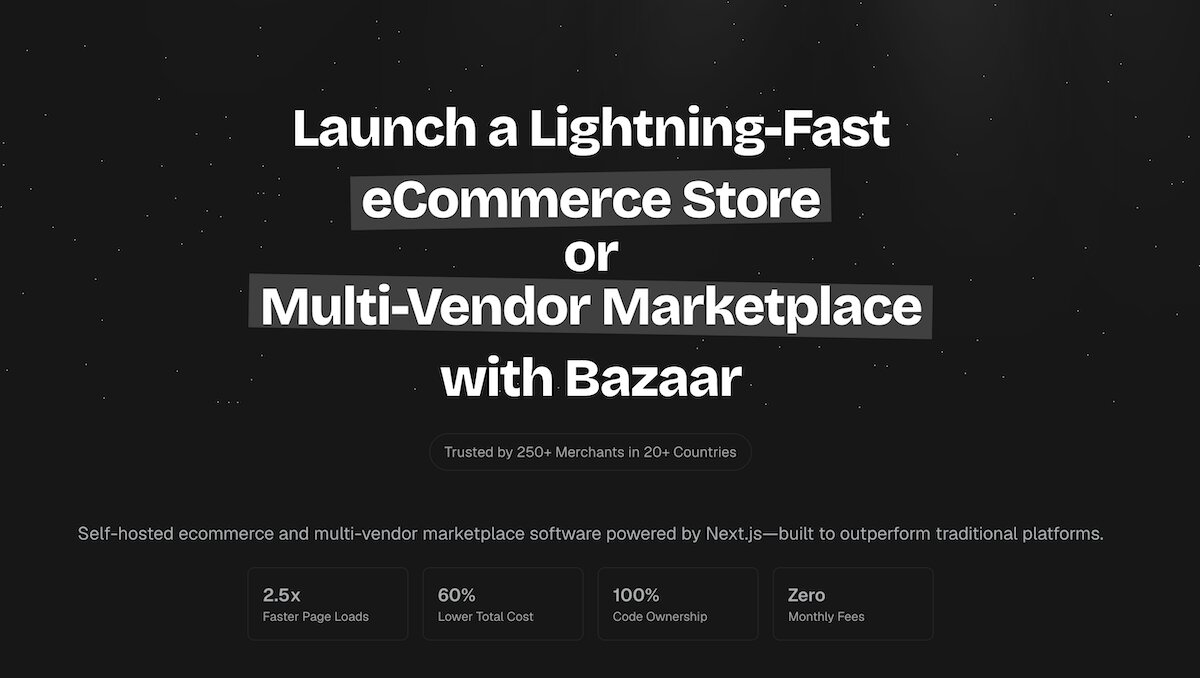
For founders who want the performance and flexibility of Next.js without the recurring costs of Shopify or the high upfront development of a fully custom build, Bazaar offers a compelling third path. It’s a complete Next.js eCommerce platform—multi-vendor marketplace, admin panel, vendor dashboard, payment processing, and full source code—for a one-time payment of $199.
Tech Stack
| Component | Bazaar |
|---|---|
| Framework | Next.js 16 + App Router + TypeScript |
| Database | Prisma ORM + MongoDB |
| Payments | Stripe, PayPal, COD |
| Multi-vendor | Built-in—vendor storefronts, commission tracking, payouts |
| Admin panel | Full dashboard with analytics, order management, drag-and-drop navigation builder |
| Pricing | $199 one-time (full source code, no monthly fees, no revenue share) |
Pros
- $199 one-time payment—no monthly fees, no transaction fees, no revenue share
- Full source code included—you own everything, self-host anywhere
- Next.js 16 + TypeScript—modern stack with Server Components for performance
- Multi-vendor marketplace out of the box—vendor storefronts, commission tracking, split payments
- 18+ homepage variations—flexible design without custom development
- No platform lock-in—customize, extend, or rebuild as your business grows
Cons
- Smaller community than Shopify’s massive ecosystem, though active and growing
- No built-in app marketplace—extend via code since full source is included
- Hosting access required—buyer provides a Vercel/Railway/AWS account; Bazaar team deploys on your server
- $199 one-time may seem higher upfront than $39/mo, but saves thousands over time
Total Cost of Ownership: Year 1 vs Year 3 vs Year 5
This is where the long-term math changes everything. A Shopify vs Next.js for e-commerce decision at Year 1 looks very different at Year 5. Here’s the real cost projection for a store doing $200K/year in revenue:
| Cost | Shopify (Advanced) | Next.js Custom | Bazaar |
|---|---|---|---|
| Year 1 | $4,788 + $4,800 (transaction fees) + $1,200 (apps) = $10,788 | $15,000 (build) + $3,600 (hosting) = $18,600 | $199 (one-time, deployed by Bazaar team) + $2,400 (hosting at $200/mo) = $2,599 |
| Year 3 | $32,364 cumulative | $25,800 cumulative | $7,399 cumulative |
| Year 5 | $53,940 cumulative | $33,000 cumulative | $12,199 cumulative |
| 5-year savings vs Shopify | — | $20,940 | $41,741 |
Note: Transaction fees for Next.js and Bazaar use Stripe’s standard 2.9% + $0.30, comparable to Shopify’s fees. Hosting for Next.js/Bazaar is $5–$200/mo (low traffic: $5/mo VPS, Vercel Pro: $20/mo, high traffic: ~$200/mo). The difference is no platform subscription and no paid apps. For stores processing $500K+/year, the cumulative savings widen dramatically.
Feature Comparison Matrix
| Feature | Shopify | Next.js Custom | Hydrogen | Bazaar |
|---|---|---|---|---|
| Time to first sale | ✅ 7–14 days | ⚠️ 2–6 months | ⚠️ 2–4 months | ✅ Within 24 hours |
| Multi-vendor marketplace | ❌ Requires app ($79/mo+) | ✅ Custom build possible | ❌ Requires app | ✅ Built-in |
| Transaction fees | ⚠️ 2.4–2.9% | ⚠️ 2.9% (Stripe only) | ⚠️ 2.15–2.9% | ⚠️ 2.9% (Stripe only) |
| Monthly subscription | ❌ $39–$2,300/mo | ✅ $0 | ✅ $0 (with Plus) | ✅ $0 |
| Full source code | ❌ No | ✅ Yes | ❌ No | ✅ Yes |
| App ecosystem | ✅ 8,000+ apps | ❌ Build everything | ⚠️ Shopify apps + headless CMS | ⚠️ Extend via code |
| Self-hosted | ❌ No | ✅ Yes | ✅ Yes (with effort) | ✅ Yes |
| LCP performance | ⚠️ 2.0–2.5s | ✅ <1.8s | ✅ <1.8s | ✅ <1.8s |
| Design flexibility | ⚠️ Theme-limited | ✅ Unlimited | ✅ High | ✅ High (18+ home variants) |
Decision Framework: How to Choose
Answer these 4 questions honestly. Your answers will tell you which path is right:
- How quickly do you need to launch? If the answer is days, choose Shopify or Bazaar (Bazaar team deploys within 24 hours). If you have 2+ months, custom Next.js becomes viable.
- What’s your monthly revenue? Under $40K/mo? The transaction fees on Shopify are meaningful but manageable. Over $100K/mo? The math heavily favors a Next.js-based solution where you keep the ~2.9%.
- Do you have a developer on the team? No developer = Shopify, Hydrogen, or Bazaar (Bazaar team deploys for you). Developer available = Next.js custom or Bazaar.
- Do you need multi-vendor or marketplace features? Yes = Bazaar (built-in) or custom Next.js. Shopify needs expensive third-party apps.
Checklist: What to Look for in Your eCommerce Solution
- ✅ Total cost over 3 years—include subscriptions, transaction fees, apps, and development
- ✅ Time to first sale—how fast can you start generating revenue?
- ✅ Development resources—do you have a team or a budget for one?
- ✅ Performance requirements—do you need sub-2s LCP for Core Web Vitals?
- ✅ Multi-vendor capability—do you need a marketplace or single store?
- ✅ Exit flexibility—can you take your code and data elsewhere if needed?
- ✅ Platform lock-in risk—how hard is it to migrate later?
Summary — Which One Wins?
There is no universal winner in the Shopify vs Next.js for e-commerce debate—the right answer depends on your specific situation:
- Choose Shopify if you need to launch fast, don’t have a developer, or have a standard catalog under 500 SKUs.
- Choose Next.js Commerce if you have development resources, need custom features, and want full control over performance and design.
- Choose Hydrogen if you’re on Shopify Plus and want headless performance while keeping Shopify’s checkout and backend.
- Choose Bazaar if you want the power of Next.js with a one-time payment of $199, built-in multi-vendor marketplace, full source code, and zero monthly fees. Explore the full solution at getbazaar.io or the Next.js eCommerce template.
The smartest move? Run the math for your revenue projection. For most stores doing over $200K/year, the long-term savings of a Next.js-based solution (with or without Bazaar) justify the upfront investment within 12–24 months.